The journey comes first
You leave London after lunch, settle into the aircraft, and imagine stepping into the car at Courchevel with the slopes and chalet already within reach. That is the promise of a well-planned winter journey: not simply a private aircraft, but a calm, coherent route from departure to resort.
Courchevel is also where that promise needs to be tested properly. Its altiport is among Europe’s most demanding operating environments, shaped by terrain, a short sloping runway, weather and strict access rules. Conditions that are manageable at a major gateway such as Geneva may still make a Courchevel arrival inappropriate or unavailable.
A jet does not land at Courchevel Altiport. The current French aeronautical publication limits the airfield to helicopters and propeller aircraft up to 5.7 tonnes certified maximum take-off mass. That matters, but it is not merely an aircraft-category rule. It is a reminder that the most attractive-looking route is not always the most dependable one.
The closest aircraft may be the wrong journey
An aircraft can be technically suitable for a mountain airfield without being commercially available to charter there. The pilot must hold the relevant mountain qualification or valid site authorisation. Larger single-engine aircraft and twin-engine aircraft require a dossier covering the pilot, operating instructions, limitations and abnormal procedures. Public-transport operations require further operator and DSAC Centre-Est approvals. Chambéry Airport currently identifies Alpine Airlines as the only airline authorised for commercial aeroplane operations at Courchevel and Megève altiports.
That distinction matters. A privately operated aircraft that is permitted, a suitably authorised aircraft-and-pilot combination, a commercial carrier authorised to carry paying passengers, and a final itinerary that works for the client are not interchangeable ideas.
Why the runway changes the itinerary
Courchevel sits at about 2,000 metres. Its runway is approximately 537 metres long and reaches an 18.6% gradient. Aircraft land uphill and depart downhill. Night VFR is not approved, and the published environment includes winter snowbanks, low sun on final approach and intensive mountain activity.
The safe operating procedure belongs to the authorised pilot, aircraft and operator. Mountain procedures establish decision points, and beyond the approved point a safe go-around may no longer be available. That is more accurate than the theatrical claim that every arrival has a universal ‘no go-around’ rule.
The municipal rule publishes a normal aerodrome window of 09:00 to 19:00 local unless the operator agrees otherwise. The AIP publishes seasonal AFIS hours and states that the rest of the year’s service is announced by NOTAM. Those facts describe year-round operations, not a December-to-April airfield; winter is the peak ski period, not the whole operating year.
Courchevel runway logic
Approximate profile - operating procedures remain aircraft and operator specific
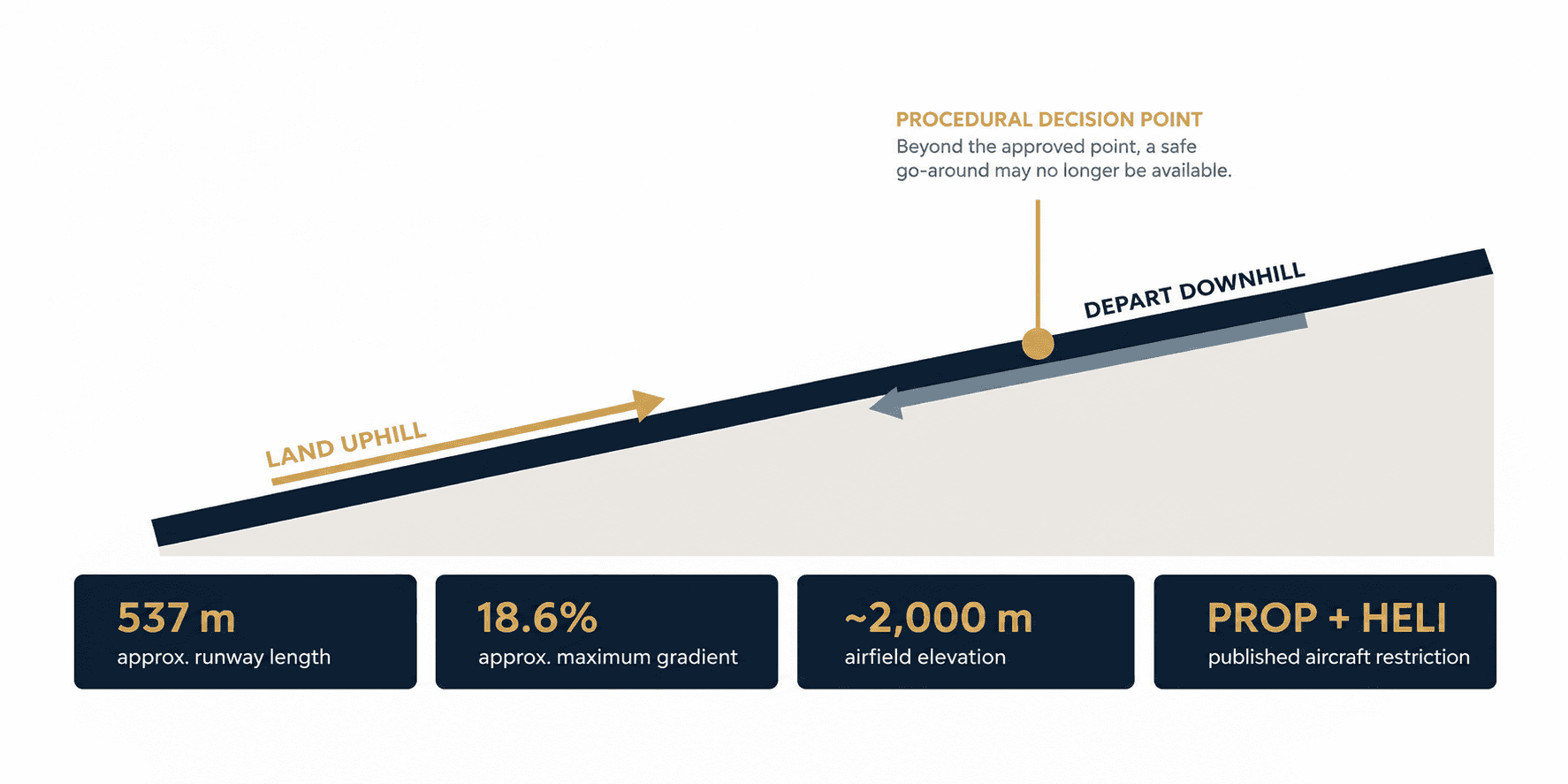
At Courchevel, runway geometry becomes part of the itinerary.
When certainty matters more than the closest landing
A Courchevel arrival can be memorable when the aircraft, crew, authorisations and mountain weather all align. It should not, however, be treated as the only premium way to reach the resort.
When timing is non-negotiable, the party is larger, baggage is substantial, or the client simply prefers a more resilient plan, a jet into Chambéry, Geneva or Lyon may be the better choice. From there, the final leg can be designed around the day: a chauffeured road transfer, or a helicopter transfer where weather, availability and approvals allow.
This is not a lesser itinerary. It is often the one that gives the client more control. The right question is not whether Courchevel can be reached directly, but which complete journey is most likely to deliver the client to the chalet calmly, safely and on time.
Four gateways are commonly considered
Chambéry, Geneva, Lyon and Grenoble are common gateways rather than an exhaustive list. The best choice depends on the inbound route, aircraft capability, border formalities, slots, parking, weather and the resilience of the onward plan.
Chambéry usually offers the least road exposure, but winter demand can tighten slots, stands and opening-hour flexibility. Geneva often offers stronger long-haul connectivity and established helicopter options, but it also operates slot and PPR controls; a helicopter stand must be reserved, and a PPR does not itself guarantee parking. Lyon may provide a stronger network and operating-hours fallback at the price of a longer road leg. Grenoble can be useful for the right seasonal route, although capacity, handling and onward transport still need date-specific confirmation.
Road and helicopter transfer times are planning estimates, not promises. Weather, traffic, border processing and peak Saturday congestion can change the answer. A Swiss arrival through Geneva also changes the customs and immigration path for some passengers and itineraries. The chosen plan should name who coordinates the last leg and what happens if the altiport or helicopter sector becomes unavailable.
Four gateways, one complete journey
The best gateway depends on resilience, not road distance alone

Availability and transfer time vary by date, weather and traffic. Closest on the map is not always quickest - or most dependable - on the day.
When the smaller aircraft is the better answer
A suitably authorised commercial propeller operation can be the right answer for a small party when mountain arrival is genuinely valuable and the weather plan is acceptable. A jet into a gateway can be the better answer when the sector is long, the party or baggage load is larger, international connectivity matters, or the schedule needs stronger weather resilience.
Neither choice is inherently more sophisticated. They protect different priorities. The important comparison is between complete journeys, including the final aircraft or helicopter’s passenger limit, skis and rigid baggage, road backup, border formalities and responsibility when the plan changes.
What the charter request should settle
Confirm whether commercial altiport access is available for the actual date, passengers and baggage.
State the full baggage profile, including skis, hard cases, mobility equipment and anything that cannot be split.
Price and reserve the helicopter or road transfer with a named fallback, not as a later add-on.
Confirm slots, parking, operating hours, handling and border requirements for the gateway and last leg.
Agree who remains accountable for updates and coordination if weather removes the mountain sector.
Peak dates reward early planning because several scarce resources must align at once. The final leg belongs in the request from the beginning.
Where OPES JET fits
OPES JET enables the client to describe the complete mission before participating carriers submit offers. The client contracts directly with the selected carrier. For Courchevel, that means the requested endpoint, commercial-access requirement, baggage, gateway, transfer and contingency should be visible before prices are compared.
A lower offer that ends in the wrong valley, excludes the transfer or relies on an unavailable mountain sector is not the same journey. Clients who want a human layer can involve Olympus to translate preferences into a coordinated brief, subject to current service confirmation. OPES JET makes the market more intelligent. Olympus makes that intelligence feel personal.
Common questions
Can a private jet land at Courchevel?
A jet cannot use the altiport under the published aircraft restriction. Commercial access by a suitable propeller aircraft also depends on the carrier, aircraft, pilot and operation holding the necessary approvals.
Which gateway is closest to Courchevel?
Chambéry usually creates the shortest road leg, but date-specific slots, parking, weather and operating hours can make another gateway more dependable.
Can a helicopter complete the journey?
Often, subject to weather, passenger and baggage limits, operating permissions, available stands and a confirmed road fallback.
Is Courchevel open only in winter?
No. The aerodrome publishes year-round arrangements, while AFIS schedules and activity vary by season and NOTAM.
Authoritative sources
Operational and product information can change. The selected carrier must confirm the current position for the actual date, route and aircraft.
French SIA current eAIP cycle and Courchevel VAC
French SIA Courchevel LFLJ aeronautical chart
SUP AIP 165/2026 for Courchevel helicopter trajectories
Courchevel municipal operating rules
Chambéry Airport commercial altiport authorisation information
Geneva Airport PPR and helicopter stand rules